How Insurance Teams Can Automate Underwriting, Claims, and Broker Presentation Workflows
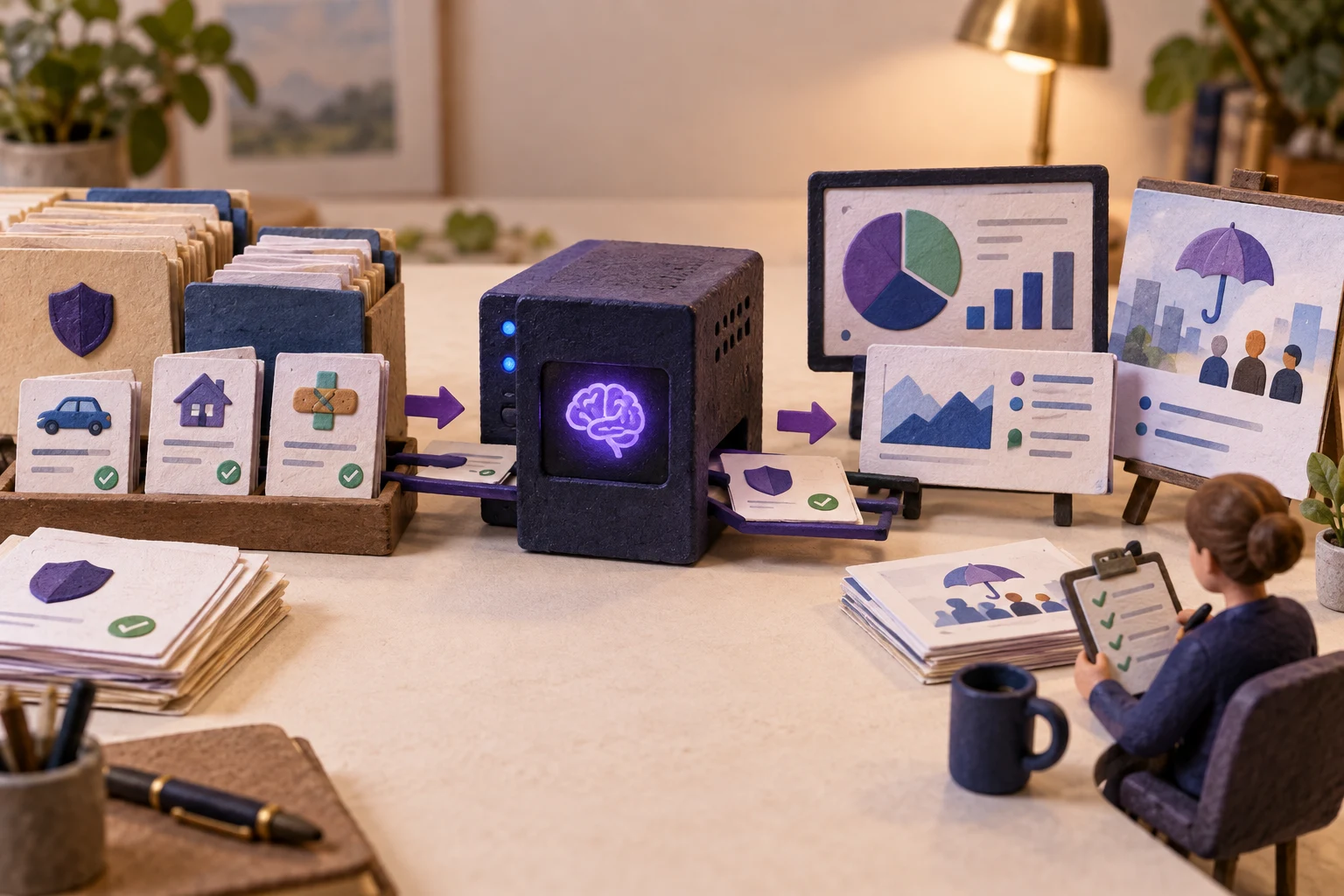
Insurance teams can use private AI to prepare underwriting, claims, portfolio, and broker presentations when jobs are limited to authorized records, material calculations are validated outside the model, and accountable insurance owners approve the final deck. Private AI supports preparation and composition; it does not make a coverage, underwriting, or claims decision.
Can insurance teams automate underwriting, claims, and broker presentations with private AI?
Yes, as a controlled drafting workflow around approved policy, claims, exposure, and portfolio data. Private AI can help turn authorized inputs into editable presentations, but it does not make an underwriting or claims decision, establish coverage, or remove the need for licensed and accountable review.
A practical workflow limits the records a job can read, preserves reporting periods and policy definitions, routes processing through approved infrastructure, and keeps a named insurance owner responsible for the final deck.
automate preparation and composition while keeping risk selection, claims judgment, customer communication, and approval with the accountable team.
Insurance workflows that make useful first pilots
| Artifact | Typical approved inputs | Review focus |
|---|---|---|
| Underwriting portfolio review | Validated exposure summaries, policy counts, loss experience, and approved market context. | Period, denominator, segmentation, assumptions, and policyholder confidentiality. |
| Claims operations review | Aggregated claim volumes, cycle time, severity bands, reserve context, and action items. | Definitions, outliers, privacy, causation language, and escalation decisions. |
| Broker or producer briefing | Approved product information, appetite guidance, market updates, and service metrics. | Coverage wording, jurisdiction, customer suitability, commitments, and approval. |
| Executive risk update | Validated portfolio indicators, scenarios, controls, and management decisions. | Model assumptions, uncertainty, materiality, source traceability, and release audience. |
Trace insurance data from source system to released deck
Insurance data can be exposed through extraction, enrichment, images, previews, logs, backups, and links as well as the main model. Document the complete path before calling it private.
| Layer | Questions to answer |
|---|---|
| Source scope | Which policy, claim, customer, broker, and portfolio fields are authorized for this purpose? |
| Preparation | Where do OCR, calculations, aggregation, embeddings, and intermediate summaries run? |
| Model and dependencies | Which text, image, search, font, rendering, telemetry, and support services receive data? |
| Tenant and role access | Can teams separate carriers, lines, regions, brokers, adjusters, administrators, and vendors? |
| Retention and release | How are drafts, exports, links, logs, backups, and records retained, deleted, or placed on hold? |
A governed path from insurance data to editable presentation
- Define the decision and audienceName the portfolio, reporting period, recipients, template, approval owner, and prohibited uses.
- Minimize the source packageUse aggregated or masked fields where possible and exclude unrelated personal data, credentials, and raw notes.
- Validate calculationsCompute material metrics in an approved system and pass definitions, units, periods, and source references with the context.
- Generate a structured draftRecord model, application, template, prompt, and output versions. Mark the result as a draft.
- Review risk and customer impactCheck policy language, claims context, fairness, uncertainty, exceptions, and whether the wording implies a decision.
- Approve and releaseKeep the PPTX editable for correction. Export or share only after the accountable insurance owner approves recipients.
- Retain the evidenceKeep source version, reviewer, approval, final artifact, and deletion decision according to records and business policy.
Controls for underwriting, claims, and broker workflows
- Field-level access: limit each job to the records and fields needed for the stated purpose.
- Separation: isolate policyholders, claims, brokers, business units, tenants, and environments.
- Source traceability: preserve definitions, periods, calculations, model assumptions, and citations.
- Human accountability: require underwriting, claims, compliance, or business owners to approve the final use.
- Dependency allowlist: document models, images, OCR, storage, logs, backups, updates, and support access.
- Incident response: define stop, revoke, investigate, notify, and recover procedures for incorrect or exposed output.
Use the enterprise AI presentation tool evaluation checklist to document these controls.
How to evaluate an insurance presentation pilot
Start with one recurring portfolio, claims, or broker briefing using approved or sanitized data and a real template. Measure time to first draft and approval, data and calculation corrections, unsupported claims, reviewer minutes, accessibility and layout fixes, export success, permission enforcement, and deletion behavior.
Do not claim compliance, fairness, coverage suitability, or risk-free automation without a review of the specific product, jurisdiction, data, configuration, and operating controls.
Explore a private insurance workflow
Bring an underwriting, claims, portfolio, or broker use case with its data contract, template, reviewers, and release path. Evaluate the complete workflow before scaling.
Explore insurance workflow →Presenton references and next steps
Confirm deployment-specific details against the environment your team will operate:
- Presenton Enterprise overview - deployment, collaboration, templates, integrations, and editable output.
- Presenton documentation - application, self-hosting, providers, and workflow concepts.
- Presenton API introduction - template-based generation, editing, export, and integration.

Published on August 17, 2026