How Financial Services Teams Can Generate Board and Client Presentations With Private AI
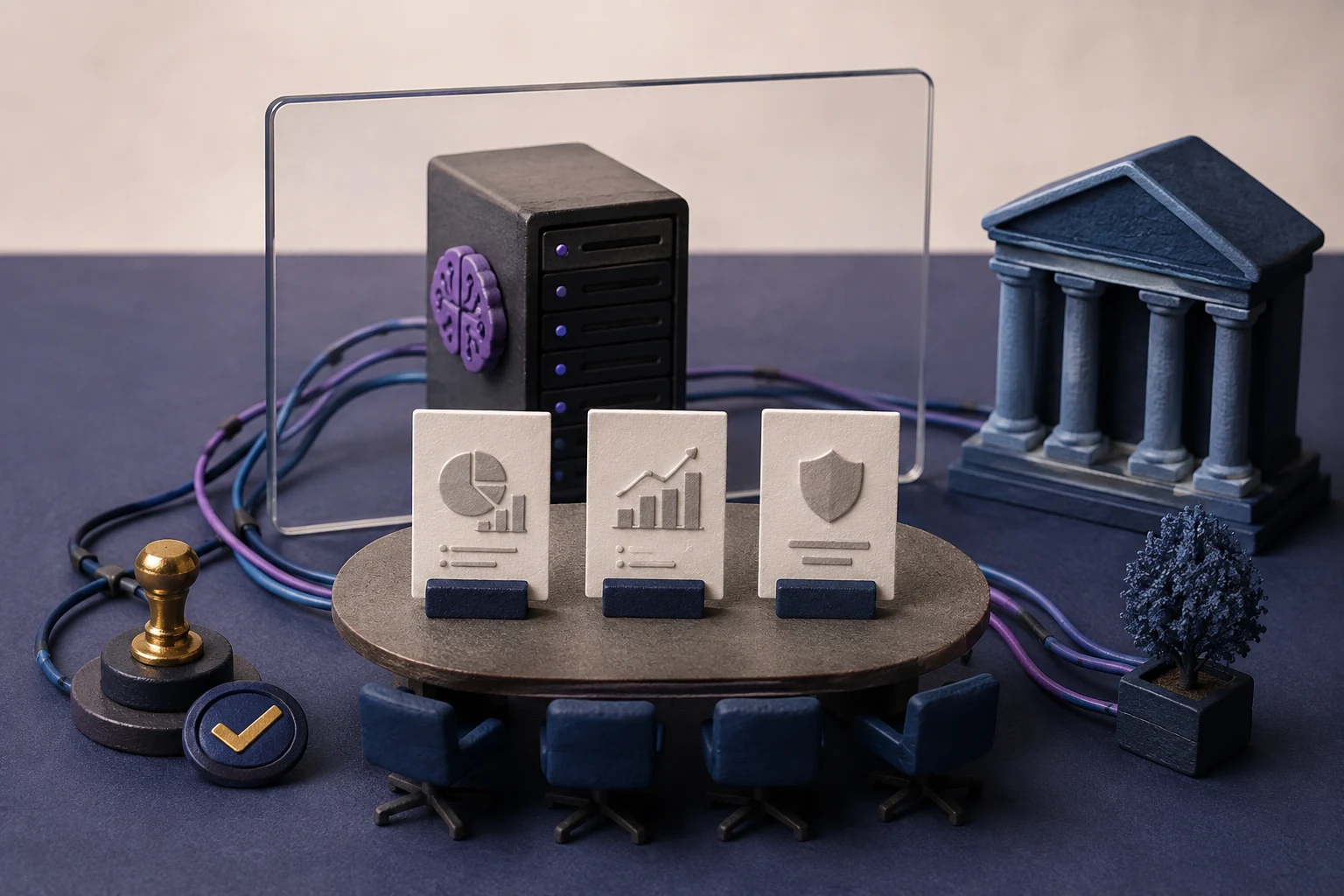
Financial-services teams can use Presenton Enterprise to turn approved financial data, portfolio commentary, and market research into editable board and client presentations without routing the working set through an unapproved public AI tool. The practical pattern is a controlled workflow: prepare the source package, use a local or approved private model, apply a governed template, collaborate in role-aware workspaces, review every material claim, and export only after approval.
Can financial-services teams use private AI for board and client presentations?
Yes—when the organization controls the source data, model route, storage, identity, template, and review steps. A private workflow can turn approved financial data, portfolio commentary, and market research into an editable presentation draft without sending the working set to an unapproved public AI tool.
Private processing is a data-boundary choice, not a compliance certificate. The generated deck remains a draft until the responsible finance, investment, relationship, risk, or communications owner checks the numbers, claims, sources, audience, and release permissions.
A controlled board-and-client presentation workflow
Use a repeatable path that starts with a locked source package and ends with a human-approved artifact.
- Lock the reporting period. Pull approved figures from the system of record and record the period, units, definitions, and source references.
- Minimize the input. Include only the financial data, portfolio commentary, market research, and instructions needed for this deck. Classify customer and material non-public information before upload.
- Generate inside the approved route. Send the prepared context to a local model or approved private endpoint. Keep calculations and reconciliations outside the language model.
- Apply the presentation system. Use a governed PowerPoint template or reference deck so layouts, fonts, colors, charts, and visual language remain consistent.
- Review with the right people. Analysts or relationship managers check the story and numbers; risk, compliance, legal, or communications owners join when the use case requires their review.
- Approve and export. Export an editable PPTX for continued editing and a PDF when a fixed-layout copy is needed. Limit downloads and recipients to the approved audience.
- Retain evidence. Keep the source version, template/model versions, reviewer, approval event, export, and retention decision according to the institution’s policy.
Where this workflow fits first
Choose a recurring artifact with a clear owner and a stable definition of done. Good starting points include:
| Artifact | Approved input | Review focus |
|---|---|---|
| Board or management pack | Period-locked KPIs, variance commentary, risk themes, and board template. | Numbers, trend explanations, material caveats, and executive readability. |
| Portfolio or market update | Approved holdings or performance summary, research notes, and market sources. | Attribution, dates, source coverage, and wording that could be read as advice. |
| Client review or QBR | Authorized account context, service metrics, portfolio commentary, and reference deck. | Client-specific facts, permissions, commitments, and recipient list. |
| Risk or control briefing | Internal risk reports, control results, incidents, and remediation status. | Severity, ownership, open actions, and separation of summary from decision. |
Keep customer-impacting decisions, investment recommendations, underwriting, credit, and other regulated determinations outside an automated drafting claim. A presentation workflow can prepare a reviewable artifact; it should not be treated as the decision authority.
Map the data boundary before calling it private
“The model runs locally” answers only one part of the question. Trace every component from upload to approved export, including OCR, image generation, previews, telemetry, backups, and support access.
| Data object | Control question |
|---|---|
| Source files and records | Which users and connectors may read them, and where are originals and extracted text stored? |
| Derived context | Where are calculations, embeddings, prompts, citations, and intermediate assets created and retained? |
| Model and image services | Does each request use a local, private, or approved provider? Is outbound access, retention, and logging documented? |
| Decks, previews, and logs | Who may view, edit, export, delete, restore, or support the output, and for how long? |
Presenton Enterprise can be deployed in cloud, VPC, on-premises, or air-gapped environments, but the exact boundary still depends on the selected deployment and its connected services. Record the exceptions instead of relying on a product label.
What Presenton Enterprise contributes
Presenton provides the presentation workflow around the model. The enterprise overview describes deployment options, customer-controlled data and documents, existing PowerPoint templates and reference decks, a UI, API, and built-in MCP server, plus editable PPTX and PDF output. Teams can connect internal tools, recurring reports, data pipelines, or AI agents and keep a person in the review loop.
| Enterprise need | How to evaluate it in the workflow |
|---|---|
| Team collaboration | Use role-based permissions, team management, and workspace separation so creators, reviewers, and administrators have distinct responsibilities. |
| Security and identity | Validate SSO/OAuth/JWT, credential handling, restricted connectivity, private storage, retention, and auditability for the chosen deployment. |
| Brand and editability | Supply an approved PPTX template or reference deck, then test fonts, layouts, charts, images, speaker notes, and editable output. |
| Automation | Connect an internal API, application UI, or MCP-enabled workflow while preserving authorization, status, download, and deletion controls. |
These capabilities support a governed workflow; they do not remove the institution’s responsibility for data classification, model risk, professional judgment, or final approval.
Examples with local models
SGLang, Ollama, and LM Studio are examples of local or private model-serving choices—not requirements. Select a compatible endpoint that your platform and security teams can operate and test.
| Example | Practical flow |
|---|---|
| Monthly board pack | Validated XLSX/PDF metrics → local OpenAI-compatible LLM served by SGLang, Ollama, or LM Studio → Presenton template → finance and executive review → editable PPTX and board PDF. |
| Portfolio client update | Approved performance summary and market research → private model endpoint → Presenton reference deck → relationship-manager review of attribution and wording → controlled client export. |
| Risk briefing | Internal risk and control reports → local text model → Presenton draft → risk-owner challenge and action check → PPTX for editing or PDF for the approved meeting pack. |
| Optional visual path | Use an internal asset library or a local image service such as ComfyUI when visuals are needed. Disable image generation when the boundary or quality policy requires it. |
Controls to agree before rollout
- Input policy: classify data, minimize fields, lock periods, and define approved connectors and file types.
- Identity and access: assign roles for generation, review, administration, export, deletion, and support; test workspace isolation.
- Model and dependency allowlist: record versions, licenses, endpoints, image services, fonts, telemetry, and outbound routes.
- Template governance: version the reference deck, brand assets, chart rules, accessibility checks, and change approvals.
- Claim and source review: require source references for material numbers and a named reviewer for each artifact.
- Retention and release: set deletion, backup, download, recipient, and incident-response rules for drafts and exports.
- Audit evidence: retain generation activity, reviewer actions, approvals, failures, and the final artifact as policy requires.
Pilot tests before production
Run the same board or client artifact through a manual baseline and a Presenton-assisted workflow. Measure factual corrections, unsupported claims, reviewer minutes, layout and export defects, time to approval, failed-job recovery, permission enforcement, and deletion behavior. Test a changed model, unavailable dependency, expired download, and revoked user—not only the successful path.
Use the evidence to decide whether the workflow is ready for more users or more sensitive data. Do not describe the pilot as compliant unless the responsible legal, risk, security, and business owners have made that determination for the specific use case and jurisdiction.
What private AI does not guarantee
Private AI can reduce exposure to unapproved external processing when the complete deployment is configured and operated that way. It does not guarantee that a deck is accurate, suitable for a client, compliant with a regulation, free of unsupported claims, or fit to make a regulated decision. Institutions remain responsible for their policies, contracts, jurisdictions, model-risk process, human review, and release authority.
Evaluate a private financial-services workflow
Bring one board pack, portfolio update, or client review to a workflow review. Map the data boundary, model route, template, reviewers, and editable output before expanding the pilot.
Request a financial-services workflow review →Authoritative sources and next steps
Use these references to validate product capabilities and design decisions for your deployment:
- Presenton Enterprise overview — deployment choices, collaboration, templates, integrations, security, and editable output.
- Presenton security overview — identity, access, data paths, retention, and deployment-specific review topics.
- Presenton documentation — application and API concepts to confirm against the edition you operate.
- Presentation export reference — export a presentation for downstream PPTX/PDF handling.
- NIST AI Risk Management Framework Core — a reference for assigning AI risk-management responsibilities; it is not a compliance determination.
Next, select one recurring artifact, name the business and control owners, document every data path, and run the pilot tests above. Read the broader private-AI banking and financial-services guide for additional governance context.

Published on August 17, 2026